💡 3 Essential Tweaks from 3D Character Artist Minjeong Shin for Stellar Stylization
1. The Foundation is Key: Prioritize Basic Shapes
It’s not just about learning the technique of sculpting; it’s about shifting how you think about the character’s fundamental forms. Shin emphasizes that the “basic shape” is the bedrock of any compelling stylized character. By dedicating ample time to establishing clean, intentional geometric shapes for the face and body, you build a solid base that makes all subsequent detailing and stylization efforts more effective and natural-looking. This means carefully considering the overall silhouette and major forms before diving into finer details.
2. Efficient Workflow: Sculpting and Retopology Synergy
Shin’s approach highlights how crucial it is to integrate sculpting and retopology seamlessly. Instead of viewing them as separate stages, understand how your sculpting decisions directly influence your retopology workflow. This means focusing on creating clean topology loops during sculpting where needed, especially around areas that will require deformation or intricate detail. This foresight dramatically cuts down production time later by minimizing the need for extensive cleanup and rework, leading to a more efficient pipeline.
3. The Devil’s in the Details: Refining Expressions and Anatomy
The real magic in stylized characters often lies in the nuanced details, particularly facial expressions and anatomical accuracy within the chosen style. Shin’s method involves a deep dive into understanding the muscles that drive facial expressions, allowing for more believable and impactful character emotions. Similarly, the extensive exercises covering hands, feet, and body poses provide a critical understanding of anatomy that translates into more dynamic and natural-looking characters, even within a stylized context. Mastering these details is what elevates a good character model to a truly memorable one.
🛠️ Key Skills & Details That Define Professional Quality
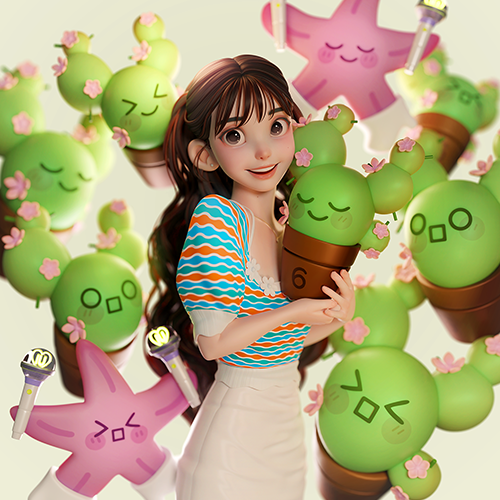
When aiming for professional-quality stylized characters, the focus shifts from simply mimicking forms to understanding the underlying principles. For 3D Character Artist Minjeong Shin, this translates into a few core technical practices:
- Intentional Sculpting: It’s not just about pushing and pulling vertices. Shin’s approach emphasizes understanding how specific brush strokes and masking techniques can define the character’s silhouette and unique features efficiently. They often demonstrate how to use proportional editing and symmetry tools to maintain consistency across the model while developing distinct personality traits.
- Strategic Retopology: The goal isn’t just a clean mesh; it’s a mesh optimized for deformation and detail. Shin consistently advises on building retopology with animation and texturing in mind. This involves understanding edge flow around crucial areas like eyes, mouths, and joints to ensure smooth deformation. Their workflow often includes using Blender’s built-in retopology tools and useful add-ons for creating clean topology with fewer steps.
- Anatomical Understanding for Stylization: Even within stylized designs, a solid grasp of human anatomy is vital. Shin breaks down complex forms into manageable geometric shapes, making it easier to capture the essence of proportions for faces, hands, and bodies. This allows for the creation of diverse characters, from slender to more robust figures, with a consistent and appealing stylistic approach. The 70 exercises provided cover a vast range of these fundamental studies.
💬 Frequently Asked Questions
Q. As a 3D Character Artist, what’s the most common mistake beginners make when starting with stylized character sculpting in Blender?
A. A frequent pitfall for aspiring 3D Character Artists is rushing the initial blocking phase. Instead of focusing on establishing strong, clear basic shapes and silhouettes, beginners often jump into detailed sculpting too early. This leads to characters that lack a cohesive form and can be difficult to correct later. Shin’s emphasis on foundational shapes in their curriculum is crucial for avoiding this common error.
Q. How does 3D Character Artist Minjeong Shin suggest balancing stylization with anatomical accuracy in Blender?
A. 3D Character Artist Minjeong Shin advocates for understanding fundamental anatomy as the “skeleton” upon which stylization is built. They demonstrate how to exaggerate or simplify anatomical features based on the desired style, rather than ignoring them entirely. This means knowing where the major muscle groups lie and how they influence the form, even when those forms are highly stylized. The 70 exercises provide practical examples of this balance.
Q. For a 3D Character Artist looking to improve their workflow, what retopology tip from Minjeong Shin’s class is most impactful for efficiency?
A. A key takeaway for improving efficiency, according to 3D Character Artist Minjeong Shin, is to plan your retopology based on your sculpting approach. They often demonstrate how to utilize sculpting tools in a way that naturally guides the retopology process, creating cleaner edge flow from the start. This proactive approach minimizes the need for extensive manual cleanup later, significantly speeding up the pipeline for creating characters.