💡 Essential Techniques for Stunning Automotive Cinematics in Unreal Engine
1. Advanced Reflection Expression Techniques
The key to lifelike automotive renders is mastering surface reflections. Version 5.1’s advancements allow for highly realistic metal and glass portrayals. Focus on leveraging LookDev skills by utilizing techniques such as Ray Tracing and Path Tracing in conjunction with Lumen. This combination ensures that reflections accurately capture the nuances of studio environments, exterior scenes, or even bustling cityscapes, bringing a dynamic realism to your vehicles. It’s not just about applying a material; it’s about understanding how light interacts with complex surfaces to sell the illusion.
2. Efficient Lighting Workflows for Dynamic Environments
Creating compelling automotive sequences demands precise control over lighting across diverse scenarios. This course delves into technical lighting knowledge specifically tailored for both indoor cyclorama studios and complex outdoor road scenes. Learn to select the optimal rendering approaches based on the specific environment and desired mood. By mastering these techniques, you can dramatically cut down production time by anticipating how lighting will behave and resolving potential issues before they become render bottlenecks, all while achieving high-resolution visual fidelity.
3. The Anamorphic Illusion Edge for New Media
For those looking to push creative boundaries, understanding real-time anamorphic illusion technology is a game-changer. This technique allows for the rapid creation of sophisticated new media content without the lengthy render times typically associated with traditional video production. The ability to quickly iterate and preview these effects in real-time within Unreal Engine means you can achieve impactful, visually striking results that stand out, whether for advertising or virtual production projects. This one extra step can elevate your output from standard to groundbreaking.
🛠️ Key Skills & Details That Define Professional Quality
https://cdn.day1company.io/prod/uploads/202302/060812-879/3ddesign-choyoungjo2-sellingpoint-02.png
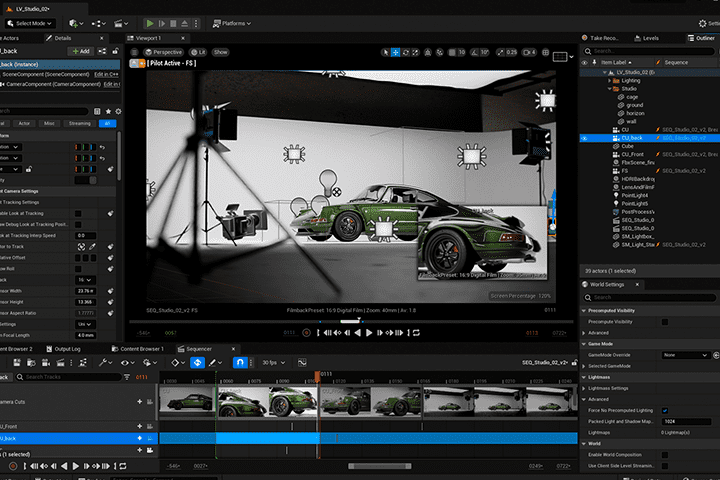
Beyond the fundamentals of 3D modeling and basic scene setup, achieving professional-grade automotive cinematics in Unreal Engine hinges on mastering advanced real-time rendering. This involves a deep understanding of how rendering methods like Ray Tracing and Path Tracing, coupled with Lumen’s global illumination, dynamically handle complex lighting scenarios. Professionals leverage these tools not just for their visual output, but for their efficiency in iteration.
The ability to instantly see the impact of lighting changes on reflective surfaces like car paint and glass is crucial. This course emphasizes practical application, moving beyond theoretical knowledge to hands-on exercises. You’ll learn to apply detailed automotive lighting expertise for various settings—from the controlled environment of a cyclorama wall studio to the unpredictable conditions of a busy road. This practical approach ensures you can create high-resolution visual images that are both technically sound and artistically compelling, effectively translating conceptual ideas into tangible, breathtaking cinematic sequences.
💬 Frequently Asked Questions
Q. How can 3D Artist Youngjo Cho’s course help improve the realism of car reflections in Unreal Engine?
A. The course provides in-depth training on advanced LookDev skills, focusing on how to utilize rendering techniques like Ray Tracing and Path Tracing with Lumen. This allows for a highly realistic portrayal of reflective materials such as metal and glass, crucial for automotive renders.
Q. What are the benefits of learning real-time anamorphic illusion technology for a 3D Artist?
A. Learning real-time anamorphic illusion allows a 3D Artist to quickly create realistic new media content without the lengthy rendering times of traditional video production. This significantly speeds up the workflow for creating eye-catching visual effects.
Q. How does 3D Artist Youngjo Cho’s approach to lighting differ for indoor versus outdoor automotive scenes in Unreal Engine?
A. The course covers detailed technical lighting knowledge applicable to various environments. For indoor scenes, like cyclorama walls, the focus might be on controlled reflections and precise illumination, while outdoor scenes on busy roads require managing diverse situational lighting and ambient conditions to achieve high-resolution visual images.