💡 Three Pillars for Elevating Your Portraiture
1. Mastering Form Through Deliberate Shading
It’s not just about learning the technique—it’s about shifting how you think about light and shadow as form-defining tools. Liang Wei emphasizes using specific brush types, like hard round brushes for initial light and shadow blocking, and then transitioning to pastel texture brushes or charcoal brushes for nuanced depth and volume. This progressive application builds form organically, rather than just painting over a flat shape.
2. The Workflow for Dynamic Lighting and Color
Efficiently handling skin tones under various lighting conditions is key. Liang Wei’s approach focuses on understanding the interplay of light, color, and mood, rather than just applying generic skin color. By layering colors and understanding how light affects hue and saturation, artists can create more believable and evocative skin tones. This often involves using specific color rendering techniques within Photoshop that allow for precise control over subtle variations.
3. Stylization as Purposeful Transformation
Simplification and exaggeration are not random acts; they are deliberate choices to enhance the essence of the subject. This course guides you to analyze a realistic portrait and identify key features to either emphasize or simplify to create a stylized effect. It’s about knowing what to change and why, ensuring your stylized version still carries the recognizable spirit of the original subject, but through your unique artistic lens.
🛠️ Key Skills & Details That Define Professional Quality
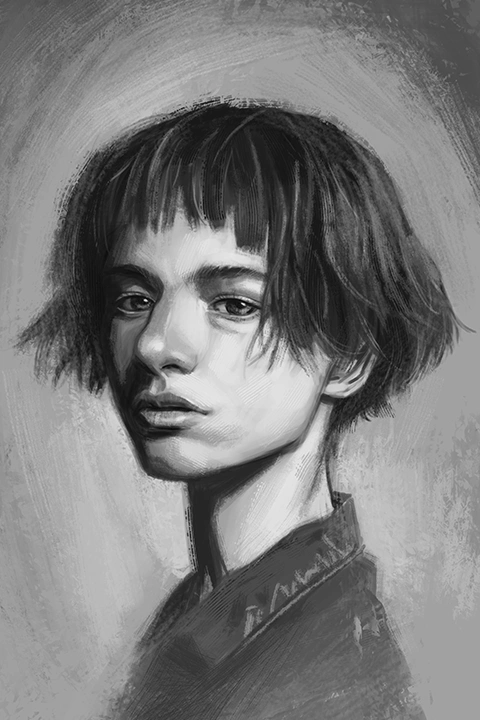
Professional portraiture, whether aiming for realism or stylization, hinges on a deep understanding of facial anatomy and the physics of light. Liang Wei’s course dives into practical applications, moving beyond theoretical knowledge to actionable techniques.
For instance, the Loomis Method is presented not just as a guideline for head proportions, but as a foundational tool for understanding how to construct a face from any angle. Mastering this allows for consistent accuracy, whether you’re drawing a frontal view or a complex three-quarter profile.
The application of shading is another critical area. Professionals don’t just “shade”; they control edges. Understanding how to create hard edges for sharp planes and soft edges for rounded forms is what gives a portrait its tactile quality and dimensionality. This is achieved through precise brushwork and understanding how different brushes interact with the digital canvas, mimicking traditional media like pastels or charcoal for specific effects.
Furthermore, the course emphasizes the strategic use of layering and color rendering techniques. This goes beyond simply picking colors; it involves understanding color theory in relation to light and mood. For example, learning how to depict skin tone under warm, cool, or dramatic lighting requires a nuanced approach to color mixing and adjustment layers, ensuring that the final piece feels cohesive and intentional. This layered approach allows for non-destructive editing and greater control over the final aesthetic.
💬 Frequently Asked Questions
Q. How does Clazroominstructor Liang Wei’s approach differ when shifting from realism to stylization?
A. Clazroominstructor Liang Wei’s method emphasizes building a robust foundation in realism first. This means mastering anatomy and lighting accurately. Stylization is then introduced as a purposeful manipulation of these realistic elements—simplifying or exaggerating features based on artistic intent, rather than a random deviation from accuracy. It’s about understanding what to change and why it serves the expressive goal.
Q. What specific tools or brushes does Clazroominstructor Liang Wei recommend for achieving realistic textures in portraits?
A. Clazroominstructor Liang Wei utilizes a variety of Photoshop brushes to achieve realistic textures. While a hard round brush is fundamental for blocking in light and shadow, the course highlights the effectiveness of pastel texture brushes and charcoal brushes for adding depth, subtle variations, and a painterly feel to skin tones and other organic surfaces. Access to a diverse brush set is encouraged for experimentation.
Q. Can I apply the lighting and color principles learned in this course to non-portrait subjects?
A. Absolutely. The core principles of light, color, and mood that Clazroominstructor Liang Wei teaches for portraiture are transferable to many other art forms. Understanding how light interacts with form, how to mix and layer colors to create specific atmospheric effects, and how to use color to convey emotion are fundamental skills applicable to landscapes, still life, character design, and more.