💡 Three Core Principles for Mastering Interactive Media
1. Understand the Fundamental Divide: Node-Based vs. Code-Based
The first crucial step is recognizing the core difference: TouchDesigner thrives on visual, node-based programming, making complex systems intuitive to build and modify without deep coding knowledge. On the flip side, p5.js leverages JavaScript for text-based coding, offering unparalleled flexibility for web integration and command-line control. It’s not just about learning a technique — it’s about shifting how you think about building interactive experiences.
2. Leverage Glitch for Seamless Web Deployment
For p5.js projects, setting up a server environment can be a hurdle. Creativecoder Jeonghyo’s go-to solution is Glitch.com. This platform allows you to deploy and host your JavaScript projects simply by uploading your files, bypassing the need for complex server configurations. You can then easily share your unique web address, making your interactive creations accessible to anyone.
3. Master Data Flow for Real-Time Communication
The magic of connecting different interactive elements, like a mobile controller to a desktop visual, hinges on real-time communication. Tools like Socket.IO, often paired with Node.js servers (which Glitch simplifies), are essential. Understanding how data flows between your input (e.g., a mobile app) and your output (e.g., a TouchDesigner render) is key to creating dynamic, responsive artwork.
🛠️ Key Skills & Details That Define Professional Quality
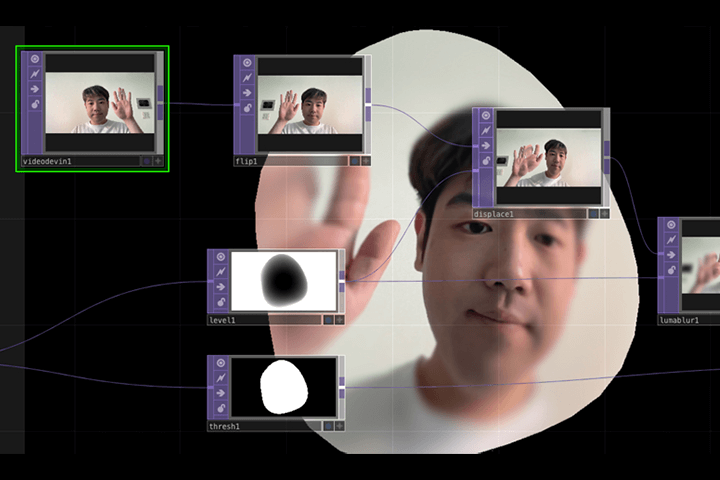 Translating visual concepts into interactive reality demands a blend of artistic intuition and technical precision. Professionals excel by not just using software features, but by deeply understanding the underlying principles of data flow and visual feedback.
For instance, when working with p5.js, it’s crucial to grasp how numerical inputs directly influence visual outputs. A simple slider in a mobile controller, sending values between 0 and 1, can dramatically alter animation speed or color intensity in your artwork. This requires a keen eye for translating abstract data into tangible visual changes.
Similarly, in TouchDesigner, the node-based system encourages a modular approach. You learn to build complex systems by connecting smaller, manageable components. Understanding the input/output relationships between these nodes, and how different data types interact, is paramount. This allows for rapid prototyping and iteration, enabling you to quickly experiment with various aesthetic directions, whether it’s creating fluid character animations that react to cursor position or building intricate generative patterns. The ability to debug and refine these connections efficiently is what separates amateur work from professional-grade interactive experiences.
💬 Frequently Asked Questions
Q. How can I make my p5.js website interactive with a mobile device?
A. Creativecoder Jeonghyo demonstrates using Glitch.com to host your p5.js project and then implementing Socket.IO for real-time communication. By creating a controller interface on your mobile device that sends commands to your hosted p5.js sketch, you can achieve seamless interaction between the two.
Q. What’s the main advantage of using TouchDesigner for interactive art?
A. TouchDesigner’s node-based visual programming environment makes it highly intuitive, even for beginners, to create real-time interactive multimedia content. Its compatibility with various tools and its visual feedback loop allow for rapid experimentation and development of complex visual systems without extensive coding.
Q. Can I combine TouchDesigner and p5.js in a single project?
A. Absolutely. The course shows how to connect p5.js web interfaces with TouchDesigner visuals. For example, data from a p5.js mobile web controller can be sent via Socket.IO to a Node.js server, which then relays that information to a TouchDesigner application, creating a unified interactive experience.