Mastering Character Face Drawing: 3 Styles & Essential Techniques
🧐 Ever feel your character faces lack that certain spark, no matter how hard you try?
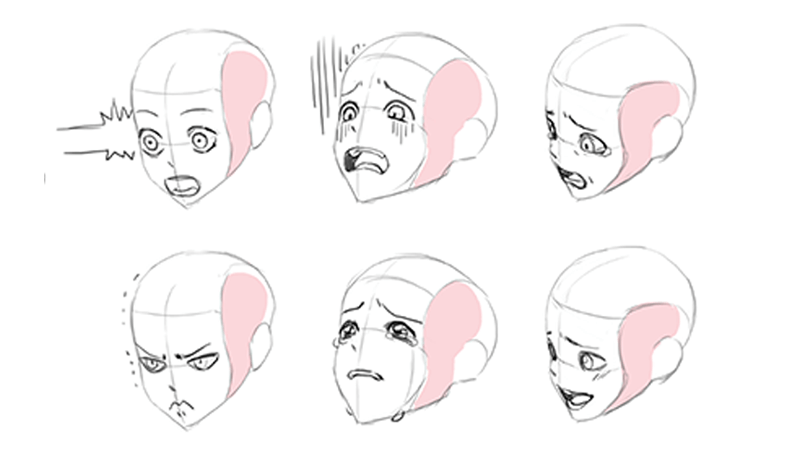 The character’s face is often the make-or-break element for truly compelling art. You follow the guides, you reference anatomy, yet the final result can still feel a bit… flat. It’s a common hurdle: translating flat references into lively, expressive characters across different styles. The frustration often stems from not understanding the subtle shifts in form and line that define each style.
💡 Key Techniques from Illustrator Osuk2 to Elevate Your Character Faces
1. Balancing Form and Style: The Core of Expressive Faces
It’s not just about learning the technique for casual, semi-realistic, or realistic styles separately. It’s about understanding how each style prioritizes different anatomical cues. For example, casual styles often omit detailed muscle structure, relying heavily on exaggerated line work and simplified shapes for eyes and mouths to convey emotion. In contrast, semi-realistic and realistic styles demand a keen understanding of how muscles affect the surface form. Mastering this means knowing when to simplify and when to render, a crucial skill for versatile character artists.
2. Strategic Simplification for 3D Form
When drawing eyes and mouths, the biggest pitfall is making them appear flat. This often happens when artists forget these features are fundamentally spherical. A practical tip is to first establish the basic spherical shape. For eyes, focus on the overall eye shape and eyebrow placement before diving into iris and pupil details. For mouths, remember the curve of the lips follows the roundness of the teeth and jaw structure. Drawing these foundational shapes accurately, even when parts are unseen due to perspective, is key to achieving that natural 3D feel.
3. The Power of Contextual Details: Beyond the Lines
In casual styles, especially, emotions are amplified through more than just facial features. Think of the supplementary visual cues: hatching to indicate paleness in fear, stylized tears for sadness, or exaggerated veins for anger. These elements act as visual shorthand. A professional artist knows how to judiciously apply these details. They aren’t just random additions; they are carefully considered to enhance the overall mood and character personality, making the expression instantly readable and impactful.
🛠️ Key Skills & Details That Define Professional Quality
The journey from a basic sketch to a polished character face involves meticulous attention to detail. For instance, when tackling different angles, particularly those looking upwards or downwards, the perceived distance between facial features like eyes and eyebrows changes. The area around the nose, often partially obscured, can be tricky. A professional workflow involves using a center line as a reliable guide for symmetry, especially when starting out. Don’t let hidden areas throw you off; focus on the visible proportions and use construction lines to maintain balance.
When rendering eyes, drawing the basic eye shape first, before adding irises and pupils, dramatically aids symmetry. For mouths, especially when open, understanding the roundness of the inner oral cavity is vital. Even without drawing every single tooth, conveying this rounded structure creates a more believable depth. Ultimately, accuracy is paramount. Building a strong foundation with precise shapes and proportions allows for speed and expressiveness to develop naturally, rather than rushing and sacrificing quality.
💬 Frequently Asked Questions
Q. How can an Illustrator balance symmetry when drawing faces from different angles?
A. Using a center line as a guide is crucial. When drawing eyes, focus on establishing the basic eye shapes first to ensure left-right balance before detailing. For mouths, especially open ones, understanding the spherical structure of the oral cavity and using center lines for proportion helps maintain symmetry. Don’t be afraid to use construction lines and check proportions frequently.
Q. What’s the biggest mistake to avoid when drawing semi-realistic character expressions for an Illustrator?
A. A common error is rendering eyes and mouths as flat shapes. These features are inherently spherical. The key is to draw them with a sense of volume, considering how they curve around the face. Even with simplified anatomy, representing this roundness will make expressions look much more natural and three-dimensional.
Q. How can an Illustrator effectively use supplementary details like sweat or tears in casual character art?
A. These details act as powerful visual amplifiers. Instead of just drawing them arbitrarily, consider their narrative purpose. Sweat can indicate exertion or nervousness, while tears clearly convey sadness or pain. Using them strategically, and in an exaggerated style fitting for casual art, can significantly boost the emotional impact of a character’s expression, making it instantly readable.