💡 3 Essential Tips for Dynamic Figure Drawing
1. Grasping Three-Dimensionality Through Simplified Forms
Instead of getting bogged down in complex muscle details from the start, focus on breaking down the human body into basic geometric shapes. Think of the torso as a box, the limbs as cylinders, and the head as a sphere or oval. Understanding how these forms interact in space is crucial for creating a sense of volume. This isn’t just about seeing shapes; it’s about shifting your mindset to construct figures from these fundamental building blocks, making your drawings feel solid and three-dimensional from the outset.
2. Streamlining Anatomy Study for Immediate Application
Many beginners get lost in the sheer volume of anatomical information. The key is to identify and focus on the most critical “landmark” bones and muscle groups that define the body’s silhouette and primary movements. For instance, understanding the pelvic girdle and the rib cage as foundational structures helps immensely with posing. Prioritize learning the anatomy that directly impacts how a character moves and expresses itself, rather than aiming for complete medical accuracy in every drawing. This practical approach ensures what you learn can be applied instantly to your character designs.
3. The ‘Flow’ Principle for Natural Expression
True natural expression in figure drawing comes from understanding the continuous flow of the body, not just static parts. Learn to see how the spine connects the torso to the limbs, and how gestures originate from the core. Practicing gesture drawing, even with simple lines that capture the overall movement and energy, is invaluable. Focus on how anatomical structures allow for a natural range of motion. This principle is about capturing the essence of movement, which makes your figures feel alive and dynamic.
🛠️ Key Skills & Details That Define Professional Quality
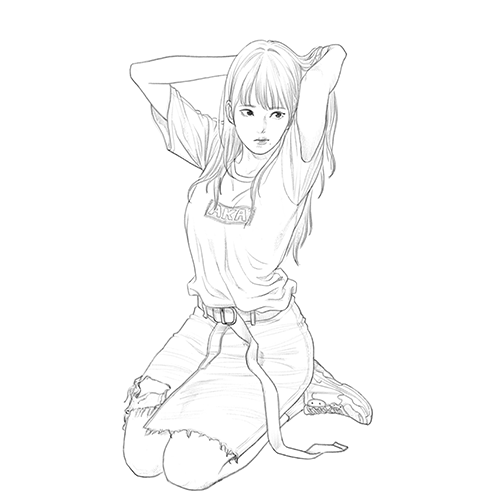
Professional illustrators excel at translating anatomical knowledge into compelling character art. This involves more than just knowing the names of muscles; it’s about applying that knowledge efficiently.
- Form-Based Construction: Consistently breaking down the body into spheres, cylinders, and boxes allows for quick and accurate blocking of poses. This approach is vital for maintaining correct proportions and volume, especially when drawing figures from challenging angles or in dynamic action.
- Landmark-Driven Anatomy: Focusing on key skeletal landmarks – like the clavicles, sternum, hip bones, and knee joints – provides a framework for understanding how anatomy affects the surface form. Knowing these points helps in accurately depicting joint rotations and the natural curves of the body.
- Gesture and Flow Integration: Professionals often start with quick gesture sketches to capture the core movement and balance of a pose. This initial step is crucial for ensuring the final drawing has dynamism. Subsequent refinement builds upon this gestural foundation, integrating anatomical understanding without sacrificing the sense of motion.
- Understanding Negative Space: Observing the shapes between body parts can be just as informative as drawing the parts themselves. This technique enhances the sense of three-dimensionality and helps in accurately capturing complex poses and overlaps.
💬 Frequently Asked Questions
Q. Illustrator Yongwoo U’s Key Insight for Beginners?
Illustrator Yongwoo U emphasizes focusing on simplified geometric forms and critical anatomical landmarks that directly influence movement and volume. The core idea is to learn what’s immediately applicable for character creation, rather than getting lost in exhaustive anatomical detail.
Q. Illustrator Yongwoo U’s Method for Natural Poses?
Illustrator Yongwoo U suggests understanding the body’s natural flow and center of gravity, often visualized from the navel. Practicing gesture drawing to capture the energy of a pose, and then building upon that with simplified anatomical structures, is key to achieving natural expression.
Q. Illustrator Yongwoo U’s Advice on Anatomy Study?
Illustrator Yongwoo U recommends prioritizing the “landmark” bones and muscles that define the body’s shape and movement for practical application in character design. This targeted approach helps beginners build a solid foundation without feeling overwhelmed by the vastness of anatomical study.